Thursday, December 27, 2012

Christmas in hospital

My sister-in-law Irene, wife to my brother Archie, spent Christmas in hospital.  She is still there.  Some days before Christmas, she was not feeling well, a condition that could probably be associated with her pregnancy entering about 30 weeks. (Yes, I will be an uncle again, early next year).

A check-up with her doctor led to the hospital stay to control her spiking blood pressure (preeclampsia).  My brother also said that the baby (yes, the BABY!) is doing great, a strong GIRL she is, the doctor says.

My folks are in Manila, upon the invitation of Archie and Irene (and the grandson Dickie!) to spend Christmas with them.  Of course, now they have been babysitting the only apo now in the Philippines (two are in the US).  While Dad jokingly said that this Manila Christmas trip isn't different from Christmases past in Mindanao because they still found themselves "alone" on Christmas Eve and Christmas Day, Mom and Dad are thankful that they are in Manila to be closer to my siblings in these out-of-the-ordinary times (and take care of Archie's household while they are in hospital).

Some days earlier, they were also in hospital to accompany my sister Aimee as she waited on her husband Raoul who had minor surgery.

I am also thankful that they are there.  Besides allowing them to be out of their ordinary schedules for about three weeks and to meet up with friends (Dad will have a get-together with former PICOP colleagues from more than 40 years back one of these days, and Dad and Mom will have lunch with Kuya's Opus Dei family sometime after the New Year), they have been given the chance to be help out Archie and Irene, Aimee and Raoul.  

I think parents are only glad to be "needed" still. 

Read Pia's "All I want for Christmas is a family".


Wednesday, December 19, 2012

Blessed are the Peacemakers (46th World Day of Peace message)

BLESSED ARE THE PEACEMAKERS

Pope Benedict XVI

"1. Each new year brings  the expectation  of a better world. In light of this, I ask God, the Father of humanity, to grant us concord and peace, so that the aspirations of all for a happy and prosperous life may be achieved.

"Fifty years after the beginning of the Second Vatican Council, which helped to strengthen the Church’s mission in the world, it is heartening to realise that Christians, as the People of God in fellowship with Him and sojourning among mankind, are committed within history to sharing humanity’s joys and hopes, grief and anguish, as they proclaim the salvation of Christ and promote peace for all.

"In  effect,  our  times,  marked  by  globalisation with its positive and negative aspects, as well as the continuation of violent conflicts and threats of war, demand a new, shared commitment in pursuit of the common good and the development of all men, and of the whole man.

"It is alarming to see hotbeds of tension and conflict caused by growing instances of inequality between rich and poor, by the prevalence of a selfish and individualistic mindset which also finds expression in an unregulated financial capitalism. In addition to the varied forms of terrorism  and international crime, peace is also endangered by those forms of  fundamentalism and fanaticism which distort the true nature of religion, which is called to foster fellowship and reconciliation among people.

"All the same, the many different efforts at peacemaking which abound in our world testify to mankind’s innate vocation to peace. In every person the desire for peace is an essential aspiration which coincides in a certain way with the desire for a full, happy and successful human life. In other words, the desire for peace corresponds to a fundamental moral principle, namely, the duty and right to an integral social and communitarian development, which is part of God’s plan for mankind. Man is made for the peace which is God’s gift.

"All of this led me to draw inspiration for this Message from the words of Jesus Christ: 'Blessed are the peacemakers, for they will be called children of God'. 

Gospel beatitude

"2. The beatitudes which Jesus proclaimed are promises. In the biblical tradition, the beatitude is a literary genre which always involves some good news, a 'gospel', which culminates in a promise. Therefore, the beatitudes are not only moral exhortations whose observance foresees in due time – ordinarily in the next life – a reward or a situation of future happiness. Rather, the blessedness of which the beatitudes speak consists in the fulfilment of a promise made to all those who allow themselves to be guided by the requirements of truth, justice and love. In the eyes of the world, those who trust in God and His promises often appear naïve or far from reality. Yet Jesus tells them that not only in the next life, but already in this life, they will discover that they are children of God, and that God has always been, and ever will be, completely on their side. They will understand that they are not alone, because He is on the side of those committed to truth, justice and love. Jesus, the revelation of the Father’s love, does not hesitate to offer Himself in self-sacrifice. Once we accept Jesus Christ, God and man, we have the joyful experience of an immense gift: the sharing of God’s own life, the life of grace, the pledge of a fully blessed existence. Jesus Christ, in particular, grants us true peace, which is born of the trusting encounter of man with God.

"Jesus’ beatitude tells us that peace is both a messianic gift and the fruit of human effort. In effect, peace presupposes a humanism open to transcendence. It is the fruit of the reciprocal gift, of a mutual enrichment, thanks to the gift which has its source in God and enables us to live with others and for others. The ethics of peace is an ethics of fellowship and sharing. It is indispensable, then, that the various cultures in our day overcome forms of anthropology and ethics based on technical and practical suppositions which are merely subjectivistic and pragmatic, in virtue of which relationships of coexistence are inspired by criteria of power or profit, means become ends and vice versa, and culture and education  are  centred  on  instruments,  technique and  efficiency  alone.  The  precondition  for  peace is the dismantling of the dictatorship of relativism and of the supposition of a completely autonomous morality which precludes acknowledgement of the ineluctable natural moral law inscribed by God upon the conscience of every man and woman. Peace is the building up of coexistence in rational and moral terms, based on a foundation whose measure is not created by man, but rather by God. As Psalm 29 puts it: 'May the Lord give strength to His people; may the Lord bless His people with peace'.

Peace: God’s gift and the fruit of human effort

"3. Peace concerns the human person as a whole, and it involves complete commitment. It is peace with God through a life lived according to His will. It is interior peace with oneself, and exterior peace with our neighbours and all creation. Above all, as Blessed John XXIII wrote in his Encyclical Pacem in Terris, whose fiftieth anniversary will fall in a few months, it entails the building up of a coexistence based on truth, freedom, love and justice. The denial of what makes up the true nature of human beings in its essential dimensions, its intrinsic capacity to know the true and the good and, ultimately, to know God Himself, jeopardises peacemaking. Without the truth about man inscribed by the Creator in the human heart, freedom and love become debased, and justice loses the ground of its exercise.

"To become authentic peacemakers, it is fundamental to keep in mind our transcendent dimension and to enter into constant dialogue with God, the Father of mercy, whereby we implore the redemption achieved for us by His only-begotten Son. In this way mankind can overcome that progressive dimming and rejection of peace which is sin in all its forms: selfishness and violence, greed and the will to power and dominion, intolerance, hatred and unjust structures.

"The attainment of peace depends above all on recognizing that we are, in God, one human family. This family is structured, as the Encyclical Pacem in Terris taught, by interpersonal relations and institutions supported and animated by a communitarian 'we', which entails an internal and external moral order in which, in accordance with truth and justice, reciprocal rights and mutual duties are sincerely recognized. Peace is an order enlivened and integrated by love, in such a way that we feel the needs of others as our own, share our goods with others and work throughout  the world  for greater communion in spiritual values. It is an order achieved in freedom, that is, in a way consistent with the dignity of persons who, by their very nature as rational beings, take responsibility for their own actions.

"Peace is not a dream or something utopian; it is possible. Our gaze needs to go deeper, beneath superficial appearances and phenomena, to discern a positive reality which exists in human hearts, since every man and woman has been created in the image of God and is called to grow and contribute to the building of a new world. God Himself, through the incarnation of His Son and His work of redemption, has entered into history and has brought about a new creation and a new covenant between God and man, thus enabling us to have a 'new heart' and a 'new spirit'.

"For this very reason the Church is convinced of the urgency of a new proclamation of Jesus Christ, the first and fundamental factor of the integral development of peoples and also of peace. Jesus is indeed our peace, our justice and our reconciliation. The peacemaker, according to Jesus’ beatitude, is the one who seeks the good of the other, the fullness of good in body and soul, today and tomorrow.

"From this teaching one can infer that each person and every community, whether religious, civil, educational or cultural, is called to work for peace. Peace is principally the attainment of the common good in society at its different levels, primary and intermediary, national, international and global. Precisely for this reason it can be said that the paths which lead to the attainment of the common good are also the paths that must be followed in the pursuit of peace.

Peacemakers are those who love, defend and promote life in its fullness
"4. The path to the attainment of the common good and to peace is above all that of respect for human life in all its many aspects, beginning with its conception, through its development and up to its natural end. True peacemakers, then, are those who love, defend and promote human life in all its dimensions, personal, communitarian and transcendent. Life in its fullness is the height of peace. Anyone who loves peace cannot tolerate attacks and crimes against life.

"Those who insufficiently value human life and, in consequence, support among other things the liberalization of abortion, perhaps do not  realize that in this way they are proposing the pursuit of a false peace. The flight from responsibility, which degrades human persons, and even more so the killing of a defenceless and innocent being, will never be able to produce happiness or peace. Indeed how could one claim to bring about peace, the integral development of peoples or even the protection of the environment without defending the life of those who are weakest, beginning with the unborn. Every offence against life, especially at its beginning, inevitably causes irreparable damage to development, peace and the environment. Neither is it just to introduce surreptitiously into legislation false rights or freedoms which, on the basis of a reductive and relativistic view of human beings and the clever use of ambiguous expressions aimed at promoting a supposed right to abortion and euthanasia, pose a threat to the fundamental right to life.

"There is also a need to acknowledge and promote the natural structure of marriage as the union of a man and a woman in the face of attempts to make it juridically equivalent to radically different types of union; such attempts actually harm and help to destabilize  marriage, obscuring its specific nature and its indispensable role in society.

"These principles are not truths of faith, nor are they simply a corollary of the right to religious freedom. They are inscribed in human nature itself, accessible to reason and thus common to all humanity. The Church’s efforts to promote them are not therefore confessional in character, but addressed to all people, whatever their religious affiliation. Efforts of this kind are all the more necessary the more these principles are denied or misunderstood, since this constitutes an offence against the truth of the human person, with serious harm to justice and peace.

"Consequently, another important way of helping to build peace is for legal systems and the administration of justice to recognize the right to invoke the principle of conscientious objection in the face of laws or government measures that offend against human dignity, such as abortion and euthanasia.

"One of the fundamental human rights, also with reference to international peace, is the right of individuals and communities to religious freedom. At this stage in history, it is becoming increasingly important to promote this right not only from the negative point of view, as freedom from – for example, obligations or limitations involving the freedom to choose one’s religion – but also from the positive point of view, in its various expressions, as freedom for – for example, bearing witness to one’s religion, making its teachings known, engaging in activities in the educational, benevolent and charitable fields which permit the practice of religious precepts, and existing and acting as social bodies structured in accordance with the proper doctrinal principles and institutional ends of each. Sadly, even in countries of long-standing Christian tradition, instances of religious intolerance are becoming more numerous, especially in relation to Christianity and those who simply wear identifying signs of their religion.

"Peacemakers must also bear in mind that, in growing sectors of public opinion, the ideologies of radical liberalism and technocracy are spreading the conviction that  economic growth should be pursued even to the detriment of the state’s social responsibilities and civil society’s networks of solidarity, together with social rights and  duties. It should be remembered that these rights and duties are fundamental for the full realisation of other rights and duties, starting with those which are civil and political.

"One of the social rights and duties most under threat today is the right to work. The reason for this is that labour and the rightful recognition of workers’ juridical status are increasingly undervalued, since economic development is thought to depend principally on completely  free markets. Labour is thus regarded as a variable dependent on economic and financial mechanisms. In this regard, I would reaffirm that human dignity and economic, social and  political factors, demand that we continue 'to prioritise the goal of access to steady employment for everyone'. If this ambitious goal is to be realised, one prior condition is a fresh outlook on work, based on ethical principles and spiritual values that reinforce the notion of work as a fundamental good for the individual, for the family and for society. Corresponding to this good are a duty and a right that demand courageous new policies of universal employment.

Building the good of peace through a new model of development and economics

"5. In many quarters it is now recognized that a new model of development is needed, as well as a new approach to the economy. Both integral, sustainable development in solidarity and the common good require a correct scale of goods and values which can be structured with God as the ultimate point of reference. It is not enough to have many different means and choices at one’s disposal, however good these may be. Both the wide variety of goods fostering development and the presence of a wide range of choices must be employed against the horizon of a good life, an upright conduct that acknowledges the primacy of the spiritual and the call to work for the common good. Otherwise they lose their real value, and end up becoming new idols.

"In order to emerge from the present financial and economic crisis – which has engendered ever greater inequalities – we need people, groups and institutions which will promote life by fostering human creativity, in order to draw from the crisis itself an opportunity for discernment and for a new economic model. The predominant model of recent decades called for seeking maximum profit and consumption, on the basis of an individualistic and selfish mindset, aimed at considering individuals solely in terms of their ability to meet the demands of competitiveness. Yet, from another standpoint, true and lasting success is attained through the gift of ourselves, our intellectual abilities and our entrepreneurial skills, since a 'liveable' or truly human economic development requires the principle of gratuitousness as an expression of fraternity and the logic of gift. Concretely, in economic activity, peacemakers are those who establish bonds of fairness and reciprocity  with their colleagues, workers, clients and consumers. They engage in economic activity for the sake of the common good and they experience this commitment as something transcending their self-interest, for the benefit of present and future generations. Thus they work not only for themselves, but also to ensure for others a future and a dignified employment.

"In the economic sector, states in particular need to articulate policies of industrial and agricultural development concerned with social progress and the growth everywhere of constitutional and democratic states. The creation of ethical structures for currency, financial and commercial markets is also fundamental and indispensable; these must be stabilised and better coordinated and controlled so as not to prove harmful to the very poor. With greater resolve than has hitherto been the case, the concern of peacemakers must also focus upon the food crisis, which is graver than the financial crisis. The issue of food security is once more central to the international political agenda, as a result of inter- related crises, including sudden shifts in the price of basic foodstuffs, irresponsible behaviour by some economic actors and insufficient control on the part of governments  and the international community. To face this crisis, peacemakers are called to work together in a spirit of solidarity, from the local to the international level, with the aim of enabling farmers, especially in small rural holdings, to carry out their activity in a dignified and sustainable way from the social, environmental and economic points of view.

Education for a culture of peace: the role of the family and institutions

"6. I wish to reaffirm forcefully that the various peacemakers are called to cultivate a passion for the common good of the family and for social justice, and a commitment to effective social education.

"No one should ignore or underestimate the decisive role of the family, which is the basic cell of society from the demographic, ethical, pedagogical, economic and political standpoints. The family has a natural vocation to promote life: it accompanies individuals as they mature and it encourages mutual growth and enrichment through caring and sharing. The Christian family in particular serves as a seedbed for personal maturation  according to the standards of divine love. The family is one of the indispensable social subjects for the achievement of a culture of peace. The rights of parents and their primary role in the education of their children in the area of morality and religion must be safeguarded. It is in the family that peacemakers, tomorrow’s promoters of a culture of life and love, are born and nurtured.

"Religious communities are involved in a special way in this immense task of education for peace. The Church believes that she shares in this great responsibility as part of the new  evangelisation, which is centred on conversion to the truth and love of Christ and, consequently, the spiritual and moral rebirth of individuals and societies. Encountering Jesus Christ shapes peacemakers, committing them to fellowship and to overcoming injustice.

"Cultural institutions, schools and universities have a special mission of peace. They are called to make a notable contribution not only to the formation of new generations of leaders, but also to the renewal of public institutions, both national and international. They can also contribute to a scientific reflection which will ground economic and financial activities on a solid anthropological and ethical basis. Today’s world, especially the world of politics, needs to be sustained by fresh thinking and a new cultural synthesis so as to overcome purely technical approaches and to harmonise the various political currents with a view to the common good. The latter, seen as an ensemble of positive interpersonal and institutional relationships at the service of the integral growth of individuals and groups, is at the basis of all true education for peace.

A pedagogy for peacemakers
"7. In the end, we see clearly the need to propose and promote a pedagogy of peace. This calls for a rich interior life, clear and valid moral points of reference, and appropriate attitudes and lifestyles. Acts of peacemaking converge for the achievement of the common good; they create interest in peace and cultivate peace. Thoughts, words and gestures of peace create a mentality and a culture of peace, and a respectful, honest and cordial atmosphere. There is a need, then, to teach people to love one another, to cultivate peace and to live with good will rather than mere tolerance. A fundamental encouragement to this is 'to say no to revenge, to recognize injustices, to accept apologies without looking for them, and finally, to forgive', in such a way that mistakes and offences can be acknowledged in truth, so as to move forward together towards reconciliation. This requires the growth of a pedagogy of pardon. Evil is in fact overcome by good, and justice is to be sought in imitating God the Father Who loves all His children. This is a slow process, for it presupposes a spiritual evolution, an education in lofty values, a new vision of human history. There is a need to renounce that false peace promised by the idols of this world along with the dangers which accompany it, that false peace which dulls consciences, which leads to self-absorption, to a withered existence lived in indifference. The pedagogy of peace, on the other hand, implies activity, compassion, solidarity, courage and perseverance.

"Jesus embodied all these attitudes in His own life, even to the complete gift of Himself, even to 'losing His life'. He promises His disciples that sooner or later they will make the extraordinary discovery to which I originally alluded, namely that God is in the world, the God of Jesus, fully on the side of man. Here I would recall the prayer asking God to make us instruments of His peace, to be able to bring His love wherever there is hatred, His mercy wherever there is hurt, and true faith wherever there is doubt. For our part, let us join Blessed John XXIII in asking God to enlighten all leaders so that, besides caring for the proper material welfare of their peoples, they may secure for them the precious gift of peace, break down the walls which divide them, strengthen the bonds of mutual love, grow in understanding, and pardon those who have done them wrong; in this way, by His power and inspiration all the peoples of the earth will experience fraternity, and the peace for which they long will ever flourish and reign among them.

"With this prayer I express my hope that all will be true peacemakers, so that the city of man may grow in fraternal harmony, prosperity and peace."

Tuesday, December 11, 2012

But not if you are yet unborn

"Palace: Human rights advocacy our policy."  

But not if you are yet unborn.  

This is what it is.  Whenever human rights are discussed, the rights of the unborn child are never included.  Unless perhaps the unborn is a "royal", since they always start to speculate whether he/she will be a king or a queen in the future.  Imagine if it were a cat in its "born" state!

Friday, December 07, 2012

It's out!

The news coming out of the Philippine media in recent days have been on the devastation brought about by Typhoon Pablo.  We pray for the survivors that they may have faith in God and in men to help them recover and move forward.

It is not any wonder, however, that the global warmists (sorry, they don't call themselves that anymore, rather the climate changers, the global climate disruptors, the new climate normal-ers), and their merry band of followers (they are everywhere) have been connecting these "extreme weather disruptions" to global warming (or climate change, or ... you get the drift).

So okay.  

But it.is.out.  Climate Depot has come out with a new report.  Read, read, read.  A good read.

But the latest peer-reviewed studies, data and analyses undermine claims that the weather is more “extreme” or “unprecedented.” On every key measure, claims of extreme weather in our current climate fail to hold up to scrutiny.

Thursday, December 06, 2012

What's in a name

A take on liberalism:

“Modern Liberalism is a utopian ideology that is predicated on the notion that, since mankind lost paradise when Adam and Eve ate from the apple of knowledge, then mankind can return to paradise if only we’d all just ‘regurgitate the apple’ and give up all knowledge of right and wrong,”

Sunday, November 25, 2012

Weather-weather

Farmers in RP might be able to get insurance coverage for climate change effects.  Might there also be insurance coverage for government's dilly-dallying on the coconut farmers right to coco levy fund pay-out?  Might there also be insurance coverage for us Filipinos due to our politicians' weather-weather policies?

Tuesday, November 13, 2012

Joey +

A little something to remember my friend Joey, who lost his battle to cancer this morning:  pictures of him and me, and his family some years back in Malaybalay, on the trip back from the Benedictine Monastery of the Transfiguration.


Thursday, October 25, 2012

The moral compass needed

The RH Bill went through some tweaks recently, but I do not think these tweaks make it any more acceptable.  For one, the  Mandatory Age-Appropriate Reproductive Health and Sexuality Education is still there.  I quote a comment on a news article that sums up my thoughts on the danger of current sex education in our schools (talks of abortion, but you get the point):
Decades have gone by since the decision was made. The ideology that abortion is OK has been brainwashed into all the school kids over these generations. Only those whose parents were able to educate them about the horror that abortion is can have a chance of being against it.

But the sexual education curriculum gets more and more perverse.
It is hard for adolescents to navigate through it without a moral compass.
Part of the reason why abortions are happening is because the youth thinks it's OK to have sex. They think contraception is safe. They think it won't fail them.

Friday, October 12, 2012

Year of Faith

October 11 is the start of the Year of Faith that the Holy Father Pope Benedict XVI wrote to us about last year.  This start coincides with the 20th anniversary of the new Catechism of the Catholic Church (commissioned by Bl. Pope John Paul II) and the 50th anniversary of the start of Vatican Council II.  

Read the Holy Father's "Door of Faith", a letter that he wrote to tell us of this year of faith, and where he also mentions how we can live this year of the faith better:  a time of witnessing for the Church and of better living charity.

One of the things we can do is to read the Catechism of the Catholic Church, to not only know more about our faith, but to increase and bring others to love our faith.  You can pick up the Catechism and have a reading plan for it for the duration of the year of faith, or, you can subscribe to Read the Catechism in a Year via flocknote.com.  It's been only just a day, so go on subscribe.

Also, pray for the proceedings of the Synod of Bishops XIII ORDINARY GENERAL ASSEMBLY (7-28 OCTOBER 2012)"Nova evangelizatio ad christianam fidem tradendam - The New Evangelization for the Transmission of the Christian Faith" now on-going.

Wednesday, October 10, 2012

An idiot god

Too good to pass ...

But there is someone even worse than a pro-choice Catholic.

Who is worse?  Their God.  The God of the pro-choice Catholic is an idiot God.

...

The God of the pro-choice Catholic says, “I have conquered death.  Now go forth and kill.”

Idiot.

Read more: Simcha

Bill of Repro rights

Sounds familiar?

“We the people of the United States hereby assert the following as fundamental human rights that no government may deny, and that our governments at every level must guarantee and safeguard for all.

1. The right to make our own decisions about our reproductive health and future, free from intrusion or coercion by any government, group, or individual.

2. The right to a full range of safe, affordable, and readily accessible reproductive health care including pregnancy care, preventive services, contraception, abortion, and fertility treatment—and accurate information about all of the above.

3. The right to be free from discrimination in access to reproductive health care or on the basis of our reproductive decisions."

These "Bill of Reproductive Rights" that many in Hollywood  subscribed to recently are not so different from what RP RH proponents want to get out of an RH Law.  From the same play book, from the same kool-aid.


H/T:  LifeNews

Tuesday, September 18, 2012

'fraidy cats

Why does our police tell us what to watch or what not to watch?  Why have they never issued an advisory like this when so many anti-Catholic and anti-Christian films and a helluva lots of other stuff have come up in the past and continue to this present day?

What hypocrisy!  Or they are simply afraid?

Two things we get out of this:

1)  They are saying that the Muslims are simply sensitive, but not sensible.  Someone makes a film they think is insulting to Islam, and they kill and pillage?  Christians most often don't?  They protest, but not to this extent?  So beware the Muslim wrath?

2)  They believe more the US pronouncements that the cause is the movie?  How much weight they put into the movie!  And they do not believe the Libyan President's version of events?

Monday, September 17, 2012

The guy should get an Oscar

Some people are giving so much weight on the film that they say is the cause of the Arab/Muslim anger in recent days, you would think they'd give the film maker and the film Oscars.  Oh, too early for Oscars?

This has the making of the a real blockbuster.  Who would have thought a short film could fire up millions of Arabs and Muslims (and the Obama administration and surrogates) into protest and killings?

Of course, this reasoning has been practically debunked by many sources even in Libya saying that that film was just a rouse.  A little to cover up something really huge, more "important" (hmm, something like the RP RH Bill, still, yeah, still pending -- let's keep it that way).

Let's all just learn this, what do you think?


H/T:  fitocracy

Monday, September 10, 2012

The value of hard work and skills gap

Come to think of it, Mike Rowe's take on the value of hard work is true everywhere. 

At cite.edu.ph, we teach them this, too.  Forza!

Tuesday, August 28, 2012

Do you also want to leave?

As a result of this, many of his disciples returned to their former way of life and no longer accompanied him.  

Jesus then said to the Twelve, "Do you also want to leave?"

Simon Peter answered him, "Master, to whom shall we go?  You have the words of eternal life.  We have come to believe and are convinced that you are the Holy One of God."

Friends have asked me about the hundred or so from Ateneo de Manila University who have voiced out their support of the RH Bill now still pending in Congress (I believe for the simple reason I went to school there, under scholarship).  

No sooner could I reply about it in this blog, when the Bishops cautioned those who signed of their obligations and rights under which a university can call itself Catholic, as well as when the president of the university unequivocally wrote that the university remains opposed to the RH Bill, while respecting individual consciences.

I am left to say that I have written many times in this blog about the way some Jesuit schools (or their personnel?) have acted in ways that I find un-Catholic university-esque.  (Hint:  SJ)

I am reminded of last Sunday's gospel passage from St. John above.  If they cannot be Catholic (they are Catholic first before a university, I must say), then by all means,  continue being a university, but please, o please, stopped being Catholic.

Friday, August 24, 2012

Obianuju to Melinda

Yes, am quoting in full.  Because am a "blogger".   And because this is too good not to quote in full.  H/T Leila.


Growing up in a remote town in Africa, I have always known that a new life is welcomed with much mirth and joy. In fact we have a special "clarion" call (or song) in our village reserved for births and another special one for marriages.

The first day of every baby's life is celebrated by the entire village with dancing (real dancing!) and clapping and singing - a sort of "Gloria in excelsis Deo."

All I can say with certainty is that we, as a society, LOVE and welcome babies.

With all the challenges and difficulties of Africa, people complain and lament their problems openly. I have grown up in this environment and I have heard women (just as much as men) complain about all sorts of things. But I have NEVER heard a woman complain about her baby (born or unborn).

Even with substandard medical care in most places, women are valiant in pregnancy. And once the baby arrives, they gracefully and heroically rise into the maternal mode.

I trained and worked for almost five years in a medical setting in Africa, yet I never heard of the clinical term "postpartum depression" until I came to live in Europe. I never heard it because I never experienced or witnessed it, even with the relatively high birth rate around me. (I would estimate that I had at least one family member or close friend give birth every single month. So I saw at least 12 babies born in my life every year.)

Amidst all our African afflictions and difficulties, amidst all the socioeconomic and political instabilities, our babies are always a firm symbol of hope, a promise of life, a reason to strive for the legacy of a bright future.

So a few weeks ago I stumbled upon the plan and promise of Melinda Gates to implant the seeds of her "legacy" in 69 of the poorest countries in the world (most of which are in Sub-Saharan Africa).

Her pledge is to collect pledges for almost $5 billion in order to ensure that the African woman is less fertile, less encumbered and, yes, she says, more "liberated." With her incredible wealth she wants to replace the legacy of an African woman (which is her child) with the legacy of "child-free sex."

Many of the 69 targeted countries are Catholic countries with millions of Catholic women of child-bearing age. These Catholic women have been rightly taught by the Church that the contraceptive drug and device is inherently divisive.

Unlike what we see in the developed Western world, there is actually very high compliance with Pope Paul VI's "Humanae Vitae." For these African women, in all humility, have heard, understood and accepted the precious words of the prophetic pope. Funny how people with a much lower literacy level could clearly understand that which the average Vogue- and Cosmo-reading-high-class woman has refused to understand. I guess humility makes all the difference.

With most African women faithfully practicing and adhering to a faith (mainly Christian or in some cases Muslim), there is a high regard for sex in society, especially among the women. Sex is sacred and private.

The moment these huge amounts of contraceptive drugs and devices are injected into the roots of our society, they will undoubtedly start to erode and poison the moral sexual ethics that have been woven into our societal DNA by our faith, not unlike the erosion that befell the Western world after the 1930 Lambeth conference! In one fell swoop and one "clean" slice, the faithful could be severed from their professed faith.

Both the frontline healthcare worker dispensing Melinda's legacy gift and the women fettered and shackled by this gift, would be separated from their religious beliefs. They would be put in a precarious position to defy their faith - all for "safe sex."

Even at a glance, anyone could see that the unlimited and easy availability of contraceptives in Africa would surely increase infidelity and sexual promiscuity as sex is presented by this multi-billion dollar project as a casual pleasure sport that can indeed come with no strings - or babies - attached. Think of the exponential spread of HIV and other STDs as men and women with abundant access to contraceptives take up multiple, concurrent sex partners.

And of course there are bound to be inconsistencies and failures in the use of these drugs and devices, so health complications could result; one of which is unintended abortion. Add also other health risks such as cancer, blood clots, etc. Where Europe and America have their well-oiled health care system, a woman in Africa with a contraception-induced blood clot does not have access to 911 or an ambulance or a paramedic. No, she dies.

And what about disposal of the medical waste? Despite advanced sewage disposal in the First-world countries, we hear that aquatic life there is still adversely affected by drugs in the system. In Africa, be rest assured that both in the biggest cities and smaller rural villages, sewage constitutes a real problem. So as $4.6 billion worth of drugs, IUDs and condoms get used, they will need safe disposal. Can someone please show us how and where will that be? On our farm lands where we get all our food? In our streams and rivers from whence comes our drinking water?

I see this $4.6 billion buying us misery. I see it buying us unfaithful husbands. I see it buying us streets devoid of the innocent chatter of children. I see it buying us disease and untimely death. I see it buying us a retirement without the tender loving care of our children.

Please Melinda, listen to the heart-felt cry of an African woman and mercifully channel your funds to pay for what we REALLY need.

We need:

- Good healthcare systems (especially prenatal, neonatal and pediatric care).
Needless to say that postpartum and neonatal deaths are alarmingly high in many Sub-Saharan African countries. This is due to the paucity of specialized medical personnel, equipment and systems. Women are not dying because they are having "too many" babies but because they are not getting even the most basic postpartum care. A childbirth or labor complication can very easily be fatal, for both mother and baby. To alleviate this problem new, well-equipped and well-staffed birthing centers with neonatal units need to be built in easily accessible parts of the poorest communities. And if Melinda Gates really insists on reducing population, she can have highly trained Natural Family Planning (NFP) instructors strategically placed in these women's healthcare facilities.  At least then there would be a natural and holistic approach.

- Food programs for young children.
This would serve a two-fold purpose if it is incorporated into free or highly subsidized nursery school programs. It would nourish and strengthen the growth of these children, who are so, so vulnerable to malnutrition, and it would also serve to encourage parents to bring their youngsters, ages 3 or 4, to nursery school. In so many parts of Africa, children miss out on nursery school education because it is expensive and considered a luxury reserved for the rich and middle class. As a result, the children miss the first few crucial years when basic math and reading are easily learned.  By the time they are considered "ready" for school, at age 7 or 8, they struggle academically. Many of them never quite catch up and so drop out after six or seven years. This is when a lot of young girls are married off as mid- to late-teenage wives who unfortunately would become the perfect recipient of the Melinda Gates comprehensive contraceptive care!

- Good higher education opportunities
Not just new school buildings or books, but carefully laid out educational programs that work - scholarships, internships at higher levels, etc. - are needed. Despite the problems and obstacles to primary and secondary education, a significant number of young girls make it into universities, polytechnics or colleges. The problem however is that, most of the schools and resources are substandard and outdated. As such, the quality of higher education is low and cannot compare to that of more privileged countries. Even though the teachers put in their very best and the students work hard, the system is inadequate and will always produce disadvantaged graduates who are not confident enough to stand with their counterparts who have studied in other parts of the world.

- Chastity programs
Such programs in secondary schools, universities and churches would create a solid support system to form, inform and reassure our young girls and women that real love is that which is healthy and holy. Many African girls are no longer sure about moral sexual ethics thanks to the widespread influence of Western media, movies and magazines. More support should be given to programs that encourage abstinence before marriage and fidelity in marriage. This approach would go a long way to combating the spread of HIV and other STDs through the continent. And it would certainly lead to happier marriages!

- Support for micro-business opportunities for women
The average African women is incredibly happy, hard-working and resilient. Any support both economic and through training would most probably be used well and wisely.

- Fortify already established NGOs that are aimed at protecting women from sex-trafficking, prostitution, forced marriage, child labor, domestic violence, sex crimes, etc.
Many of these NGOs do not have much success because they are not well-funded. Though most of them have good intentions, they lack professional input from those such as psychologists, logisticians or medical personnel needed to tackle various problems.

$4.6 billion dollars can indeed be your legacy to Africa and other poor parts of the world. But let it be a legacy that leads life, love and laughter into the world in need.

Come and see

August 24 is the feast of the apostle St. Bartholomew, famous for his "Can anything good come from Nazareth?"  Later, equally famously answered by Philip, "Come and see."

In Nagcarlan, Quezon, a main church is dedicated to St. Bartholomew (the Philippine Independent Church also has a church dedicated to the saint and located along the main road).  Here are two pictures (from three years back).  Look and see.


Later that day, we went to Bunga Falls nearby.


And then there is this

Everything is for a reason. Katie was spared so that she may do all what she does today.  And more.


Wednesday, August 15, 2012

Feast of the Assumption of Our Lady

 Sorry guys, only a repeat of the 2006 post in the meantime....


Today is the Feast of the Assumption of Our Lady. Pope Benedict XVI last year said:

Mary is taken up body and soul into the glory of heaven, and with God and in God she is Queen of heaven and earth. And is she really so remote from us?

The contrary is true. Precisely because she is with God and in God, she is very close to each one of us.

While she lived on this earth she could only be close to a few people. Being in God, who is close to us, actually, "within" all of us, Mary shares in this closeness of God. Being in God and with God, she is close to each one of us, knows our hearts, can hear our prayers, can help us with her motherly kindness and has been given to us, as the Lord said, precisely as a "mother" to whom we can turn at every moment.

She always listens to us, she is always close to us, and being Mother of the Son, participates in the power of the Son and in his goodness. We can always entrust the whole of our lives to this Mother, who is not far from any one of us.

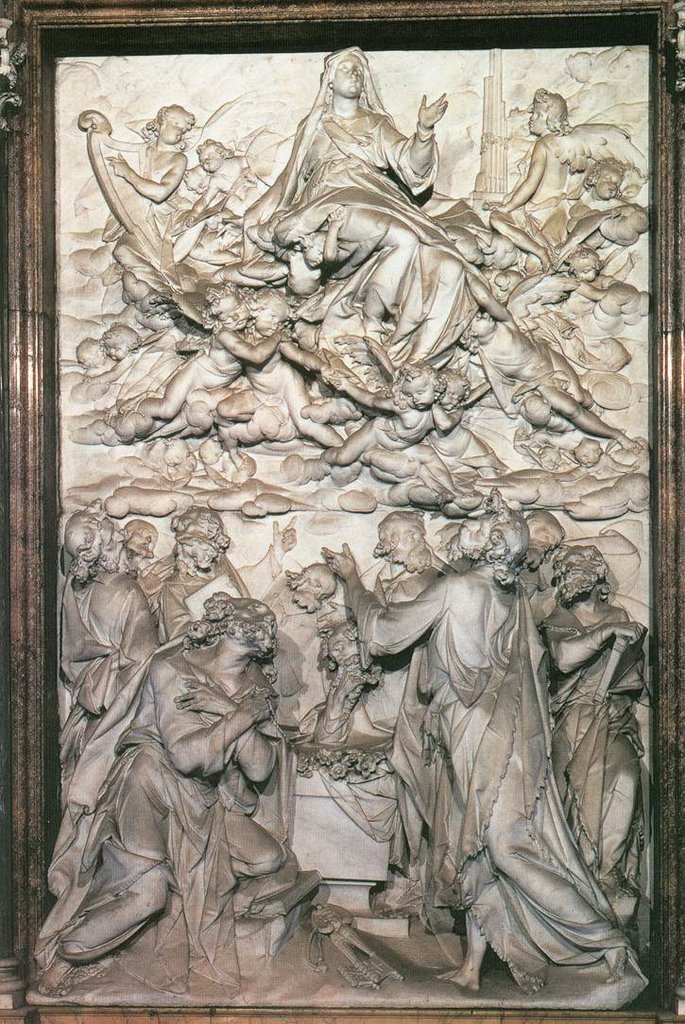
I was looking for a picture I had beside the early 17th century marble rendition of the Assumption at Sta. Maria Maggiore Basilica in Rome (by Bernini, who happens to be named Pietro -- rough translation: Peter), but could not find it as of this blogging. What's important is this work of art:

It's a holiday in Rome, too. Perhaps the Holy Father will celebrate Mass or give a homily in Castelgandolfo (as he did last year).